
Chapters
Kano
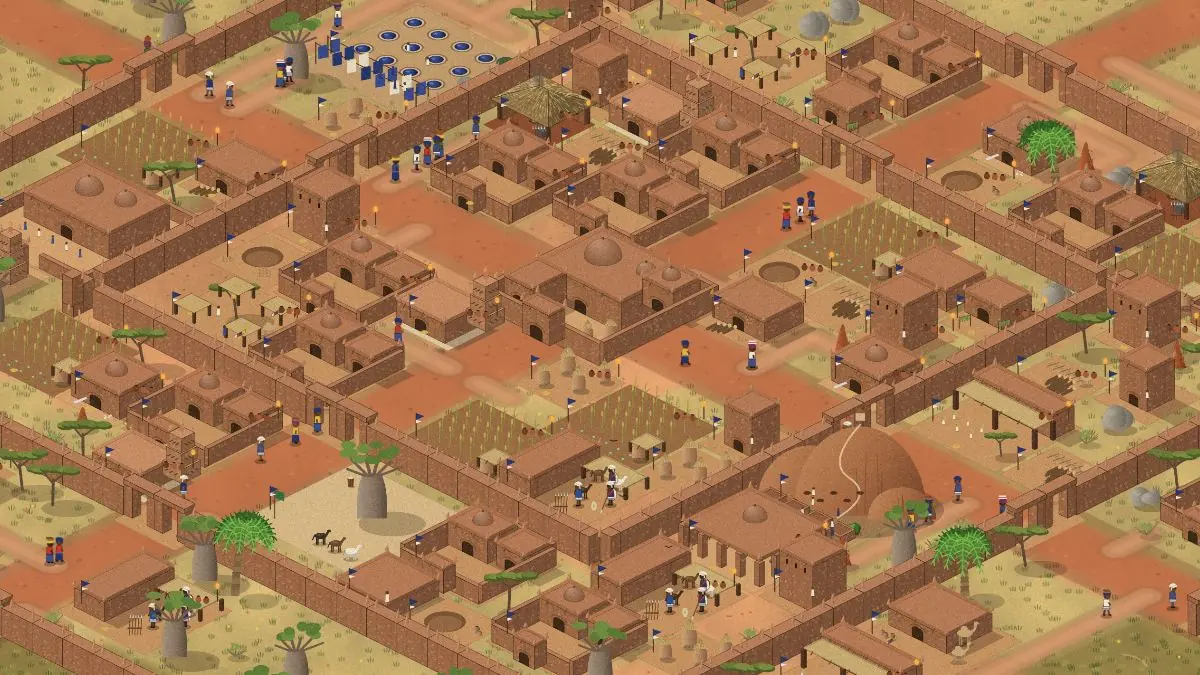
Hausa city-state · Red savanna round Dala Hill
Play KanoEra I · Before the Flag
The five ages
- 1
Rumfa’s Kano
1463–1499 · town-centre level 1Muhammad Rumfa becomes Sarkin Kano in 1463. The Kano Chronicle credits him with a new palace, the Kurmi market, a longer city wall, a council of nine and the first Sallah festival in Kano. The scholar al-Maghili writes him a guide to just rule. Raise the wall, the market and the palace.
- 2
The Katsina wars
1499–1565 · town-centre level 4Rumfa’s eleven-year war with Katsina ended with no winner. Under Abdullahi and then Muhammad Kisoki a second war begins, and Kano’s armies march on Zazzau. Camels bring salt from the desert, and kola comes up the road from Gonja.
- 3
The Kwararafa raids
1623–1807 · town-centre level 7Kwararafa raiders break one of Kano’s gates in 1653, and in 1671 its people flee to Daura. Katsina overtakes Kano as the great market of the Hausa cities. In the 1700s Babba Zaki builds up the cavalry and his bodyguard.
- 4
The Emirate
1807–1893 · town-centre level 10In 1807 the reform movement led from Sokoto takes Kano; the last sultan, Alwali, is killed, and Kano becomes an emirate of the Sokoto Caliphate, its richest. Ibrahim Dabo rules from 1819 to 1846. When Heinrich Barth arrives in 1851, cotton cloth is the city’s greatest industry.
- 5
The Scramble
1893–1903 · town-centre level 13The Basasa, a war of succession from 1893 to 1895, ends with Aliyu Babba as emir. Damagaram, Maradi and Ningi attack on three fronts. In January 1903 a British column under Colonel Morland marches from Zaria. Here your defences decide.
People of Kano
The figures who appear as the city grows, ruled by the Sarki.

Muhammad Rumfa
Sarkin Kano, 1463–1499The Kano Chronicle credits him with the palace, the Kurmi market, a longer wall and the first Sallah festival in Kano.
Portrait: fictional depiction
Muhammad al-Maghili
Scholar from TlemcenHe wrote “The Obligations of Princes”, a guide to just rule, for Rumfa.
Portrait: fictional depiction
Abdullahi Burja
Sarkin Kano, 1438–1452He opened the roads that brought camels and kola from Gonja, and paid tribute to Bornu.
Portrait: fictional depiction
Muhammad Kisoki
Sarkin Kano, 1509–1565His long reign saw the second Katsina war and a campaign against Zazzau.
Portrait: fictional depiction
Babba Zaki
Sarkin Kano, 1747–1771He enlarged the cavalry and his bodyguard.
Portrait: fictional depiction
Ibrahim Dabo
Emir of Kano, 1819–1846He restored order after years of revolt; the emirs of Kano still come from his line.
Portrait: fictional depiction
Heinrich Barth
Traveller, in Kano in 1851The German scholar put the city at about 30,000 people and found cotton cloth its greatest industry.
Portrait: fictional depiction
Aliyu Babba
Emir of Kano, 1894–1903He came through the Basasa and the three-front war, and was away at Sokoto when the British column came.
Portrait: fictional depiction
Ahmadu Mai Shahada
Waziri, died 1903He fell fighting the British on the road home from Sokoto in February 1903.
Portrait: fictional depictionYour hero in battle

The Madawaki
Commander of the horseLeads Kano’s heavy cavalry: riders and horses in lifidi, thick quilted cotton armour. Ability: Lifidi charge. The armoured horse charges together: +35% damage for 12 seconds.
Portrait: fictional depictionThe council
| Seat | Who they are | Speaks for |
|---|---|---|
| The Galadima | The senior councillor who runs the city for the Sarki | people, trade and the treasury |
| The Madawaki | Commander of the horse | the army and Peace |
| The Imam of Kano | Leads the prayers at the great mosque | Faith |
| The scholars | Teachers and copyists of the city’s schools | Progress and research |
| The Sarkin Kasuwa | Chief of the market | Wealth and Unity |
| The healer | Remedies | Health |
| The Makama | Officer of the palace and the royal household | the palace and its guests |
| The kingmakers | The Tara ta Kano, the council of nine said to go back to Rumfa | whether you keep the throne |
Sign or stand
February 1903. Colonel Morland’s column marches on Kano from Zaria: British officers, some 800 African soldiers, field guns and Maxims. The emir, Aliyu Babba, is away at Sokoto with many of his horsemen. Its terms: accept British rule over Kano.
| Sign | Open the gates and accept a British resident. The emirate survives under the protectorate. Unity falls hard for a month. |
| Stand | Man the great wall and its gates. Hold the city and history changes. |
What really happened (the game tells you at the end)
On 3 February 1903 the column shelled the walls and forced its way in, and with the emir away the city fell the same day. Later that month the Waziri was killed fighting the British on the road home from Sokoto, and Aliyu Babba was captured and exiled to Lokoja. Your city rebuilds: the column will come again while you stay in the Scramble.
Raiders and bosses
Who comes for the city in each age. Bosses come once you are into their age. How raids work.
| Age | Raiders | Boss |
|---|---|---|
| First Rumfa’s Kano | Raiders on the caravan roads | None |
| Second The Katsina wars | Katsina’s army | The second Katsina war After 1499 |
| Third The Kwararafa raids | Kwararafa raiders | The Kwararafa raid 1653: a gate of Kano broken |
| Fourth The Emirate | Raiders from Ningi | Three fronts at once Damagaram, Maradi and Ningi, after 1896 |
| Fifth The Scramble | Patrols from the Protectorate | The British column 3 February 1903 then sign or stand |
Soldiers
| Soldier | From level | |
|---|---|---|
| Spearman | Foot soldiers with spear and hide shield. | 2 |
| Archer | Bowmen who shoot from behind the spears. | 3 |
| Lifidi horseman | Heavy cavalry: horse and rider in lifidi, thick quilted cotton armour that turns arrows. | 7 |
| Musketeer | Late in the century firearms reached Kano across the Sahara. One heavy shot, a long reload. | 10 |
Buildings
Every building Kano can raise, shown as it looks in the middle of the story. What each type does.
People

Family compound
Unlocks at town-centre level 1Flat-roofed rooms of red earth plaster, an entrance hut and a clay granary inside a compound wall. Houses your people.

Healer’s house
Unlocks at town-centre level 4Herbs, roots and remedies. Raises Health. Raiders never touch it.

Alkali’s court
Unlocks at town-centre level 5The judge hears cases under a pillared roof. Raises Trust and some Peace.
Economy

Millet farm
Unlocks at town-centre level 1Millet and sorghum, with cotton and indigo in the fields beyond. Tap the farm when it fills to bring the harvest in.

Woodcutters’ camp
Unlocks at town-centre level 1Thorn wood and timber hauled in from the bush. Materials.

Tubali yard
Unlocks at town-centre level 2Tubali: cone-shaped mud bricks dried in the sun, the stuff of Kano’s walls and houses. Materials.

Granaries
Unlocks at town-centre level 1Round clay granaries raised on stones under thatched lids. Raises your Food storage; raiders can take only part of it.

Storehouse
Unlocks at town-centre level 1A flat-roofed store for timber and bricks. Raises your Materials storage.

Treasury
Unlocks at town-centre level 3Cowries and gold under a domed roof. Raises your Wealth storage.

Kurmi market
Unlocks at town-centre level 3Founded by Muhammad Rumfa and still trading today: cloth, leather, kola, salt and grain under mat roofs. Wealth.

Caravan station
Unlocks at town-centre level 10Camels unload salt from the desert and carry cloth, leather and kola north. Abdullahi Burja (1438–1452) opened the roads that brought kola from Gonja. A large Wealth producer.
Culture

Mosque
Unlocks at town-centre level 1Thick mud walls, a flat roof on palm beams and a tower for the call to prayer. Raises Faith and gives a little knowledge. Raiders never touch it.
Scholars’ school
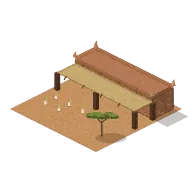
Unlocks at town-centre level 4Wangarawa scholars from Mali brought learning to Kano in the 14th century. Students write on wooden slates. Makes Knowledge and runs research. Raiders never touch it.

Durbar ground
Unlocks at town-centre level 4Open ground where the horsemen parade before the palace at the Sallah festivals. Raises Unity.

Madawaki’s house
Unlocks at town-centre level 7Home of the commander of the horse. Brings the Madawaki and his armoured riders to your army.

Gidan Makama
Unlocks at town-centre level 8An old palace of Kano, said to date from the 15th century, with carved walls and domed rooms; today it is a museum of the city’s history. Heritage for the ladder.
Defence

Watch tower
Unlocks at town-centre level 3A mud tower over the wards. Raises Peace.

Archers’ tower
Unlocks at town-centre level 2Archers shoot from a crenellated mud tower.

City wall
Unlocks at town-centre level 4Kano’s great wall was begun under Sarki Gijimasu (1095–1134). Its base was about 12 m thick, and it had 15 gates. Build it section by section.

City gate
Unlocks at town-centre level 4A kofa, a gatehouse where an avenue passes through the wall, like Kofar Mata or Kofar Nassarawa.

Musket post
Unlocks at town-centre level 10Firearms behind thick mud walls. Hits hard, reloads slowly.

War council
Unlocks at town-centre level 13The commanders plan the city’s defence against the British column. Needed to stand in 1903.
Army

Cavalry stables
Unlocks at town-centre level 2Horses, fodder and spear racks. Each level holds more soldiers.

Smiths of Dala
Unlocks at town-centre level 5Iron from Dala hill. Legend says Kano is named after a blacksmith who came to dig its ironstone. Raises Progress.
Landmarks

Dala Hill
Unlocks at town-centre level 4The hill where Kano began, mined for its ironstone and watched over by the oldest wards. Unity, Faith and visitors.

Kofar Mata dye pits
Unlocks at town-centre level 6Indigo dye pits said to date from 1498 and often called the oldest in Africa. Kano’s blue cloth went across the Sahara. Wealth and Heritage.
Research
| Technology | Branch | Effect |
|---|---|---|
| Millet and sorghum | Farming | Grain crops suited to the dry season: +10% Food. |
| Clay granaries | Farming | Raised granaries keep pests out: +15% Food storage. |
| Irrigated gardens | Farming | Onions and vegetables on the river flats: +15% Food. |
| Rice and new seed | Farming | Rice in the river valleys: +20% Food. |
| Tubali bricks | Building | Cone-shaped sun-dried bricks: builds 8% faster. |
| Makuba plaster | Building | Plaster hardened with locust-bean pods sheds the rain: buildings +10% sturdier. |
| Masons’ guild | Building | Guild masons cut the cost of building by 8%. |
| Master builders | Building | Domed rooms on palm-rib arches: builds 10% faster. |
| Iron spearheads | Defence | The smiths of Dala arm the infantry: +8% damage. |
| Archery drill | Defence | Faster, steadier volleys: towers +12% damage. |
| Lifidi armour | Defence | Quilted cotton armour for riders and horses: +12% unit health. |
| Firearms | Defence | Guns from across the Sahara: +12% damage. |
| Cowries and gold | Trade | Two ways to pay in one market: +10% Wealth. |
| Caravan roads | Trade | Safer roads to Gonja and the desert: +12% Wealth. |
| Trans-Saharan trade | Trade | Kano cloth and leather for the desert caravans: +20% Wealth. |
| Qur’anic schools | Learning | A school in every ward: +15% Knowledge. |
| Ajami writing | Learning | Hausa written in Arabic script reaches more readers: research 15% faster. |
| The Kano Chronicle | Learning | The city writes down its own history: +20% Knowledge. |
| Festival calendar | Heritage | Feasts and parades through the year: Faith and Unity rise. |
| Embroidered robes | Heritage | Master embroiderers dress the court: Heritage. |
| Kano blue | Heritage | Cloth dyed so deep in indigo it shines: Heritage. |
| The dye pits signature | Heritage | Signature tech. Dyeing at the scale of a city: Knowledge and Progress in every ward. |
| The great wall signature | Defence | Signature tech. Walls about 12 m thick at the base: city walls 25% stronger. |
Did you know?
- The Kano Chronicle names Bagauda as the first king of Kano, around 999.
- Kano grew round Dala Hill; legend says the city is named after Kano, a blacksmith who came to dig its ironstone.
- Kano’s wall was begun under Sarki Gijimasu (1095–1134); its base was about 12 m thick, and it had 15 gates.
- Muhammad Rumfa ruled from 1463 to 1499 and founded the Kurmi market.
- Gidan Rumfa, Rumfa’s palace, is still the emir’s palace today.
- The scholar al-Maghili wrote “The Obligations of Princes” for Rumfa.
- Under Rumfa, Kano and Katsina fought for eleven years with no winner.
- Abdullahi Burja (1438–1452) opened the roads that brought kola nuts from Gonja.
- Wangarawa scholars from Mali brought Islam to Kano in the 14th century.
- The Kofar Mata dye pits are said to date from 1498.
- Kwararafa raiders broke one of Kano’s gates in 1653.
- Kano became an emirate of the Sokoto Caliphate in 1807, and its richest.
- When Heinrich Barth visited in 1851, cotton cloth was Kano’s greatest industry.
- Lifidi was the thick quilted cotton armour of Kano’s heavy cavalry, for horse and rider.
- A British column took Kano on 3 February 1903.