
Chapters
Kanem–Bornu
Kanuri · Sahel on the Yobe River, west of Lake Chad
Play BornuEra I · Before the Flag
The five ages
- 1
Ngazargamu
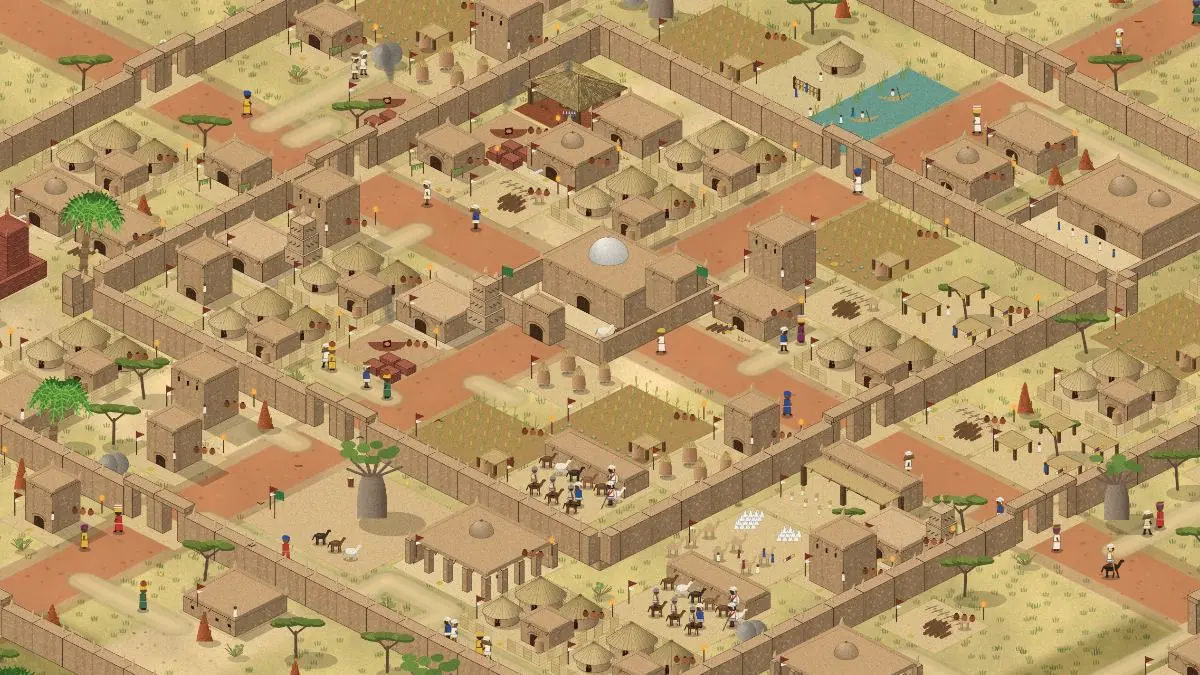
c. 1472–1560 · town-centre level 1Driven out of Kanem, east of Lake Chad, around 1380, the Sayfawa kings settle in Bornu to the west. Around 1472 Mai Ali Gaji founds a permanent capital, Birni Ngazargamu, on the Yobe River. Raise its wall, its mosques and its stables.
- 2
Idris Alooma
1560–1603 · town-centre level 4Mai Idris Alooma takes Bornu to the height of its power. In the 1570s the Ottoman sultan sends muskets and Turkish trainers; the army adds camel troops, fortified camps and ferries to cross the rivers.
- 3
The salt road
1603–1808 · town-centre level 7Bornu grows rich on the Sahara trade: salt by the thousand tons, cloth and captives go north, and horses and copper come south. Its mallams teach the Qur’an and the law, and their villages pay no tax.
- 4
Al-Kanemi
1808–1893 · town-centre level 10In 1808 Fulani armies take and destroy Ngazargamu. A scholar and soldier, Muhammad al-Amin al-Kanemi, rallies Bornu, wins near Ngala and becomes its real master; in 1814 he founds a new capital at Kukawa. In 1846 the old line of the mais comes to an end, and his son rules alone.
- 5
The Scramble
1893–1902 · town-centre level 13In 1893 Rabih az-Zubayr, a warlord from the Sudan, conquers Bornu and burns Kukawa. The French kill him at Kousséri on 22 April 1900, and in 1902 British columns march into western Bornu. Here your defences decide.
People of Bornu
The figures who appear as the city grows, ruled by the Mai.

Umar I Idrismi
Mai, c. 1380He led the Sayfawa from Kanem, east of Lake Chad, to Bornu in the west.
Portrait: fictional depiction
Ali Gaji
Mai, c. 1472He founded Birni Ngazargamu, the capital for more than three centuries.
Portrait: fictional depiction
Idris Alooma
Mai, late 16th centuryHe brought in muskets and Turkish trainers, camel troops and fortified camps.
Portrait: fictional depiction
The Kaigamas
Commanders of the armyOften men of slave birth who rose by their deeds; a beaten Kaigama could lose his post.
Portrait: fictional depiction
The mallams
ScholarsThey taught the Qur’an and the law in villages that paid no tax.
Portrait: fictional depiction
Ahmad Alimi
Mai in 1808He was the Mai when Ngazargamu fell.
Portrait: fictional depiction
Muhammad al-Amin al-Kanemi
Scholar and soldierHe saved Bornu after 1808 and founded Kukawa in 1814.
Portrait: fictional depiction
Umar, son of al-Kanemi
Ruler of BornuIn his time the old line of the mais came to an end, in 1846.
Portrait: fictional depiction
Abubakar Garbai
Shehu from 1902He made terms with the British and founded Yerwa, today’s Maiduguri, in 1907.
Portrait: fictional depictionYour hero in battle
The Kaigama
Commander of the armyBornu’s highest general, often a man of slave birth who rose by his deeds. He leads the armoured cavalry. Ability: Cavalry charge. The horsemen charge together: +35% damage for 12 seconds.
Portrait: fictional depictionThe council
| Seat | Who they are | Speaks for |
|---|---|---|
| The Galadima | Governor of the western provinces | people, trade and the treasury |
| The Kaigama | Commander of the army | the army and Peace |
| The Imam | Leads the prayers at the great mosque | Faith |
| The mallams | Scholars and teachers of the law | Progress and research |
| The salt merchants | They run the caravans | Wealth and Unity |
| The healer | Remedies | Health |
| The Magira | The queen mother, with her own lands and court | the palace and the succession |
| The council of state | Twelve royal, religious and military notables | whether you keep the throne |
Sign or stand
1902. Rabih is dead, and a British column marches into western Bornu. Its officers offer to recognise the Shehu as ruler of the country, under British protection and a British Resident.
| Sign | Accept, as the Shehu did. He keeps his title and his court, but the Resident has the last word, and Unity falls hard for a month. |
| Stand | Refuse, and send out the armoured cavalry. History went the other way; here your defences decide. |
What really happened (the game tells you at the end)
In 1902 Shehu Abubakar Garbai accepted British protection and was recognised as ruler of British Bornu. In 1907 he founded a new capital, Yerwa, which grew into Maiduguri. Your city rebuilds: the column will come again while you stay in the Scramble.
Raiders and bosses
Who comes for the city in each age. Bosses come once you are into their age. How raids work.
| Age | Raiders | Boss |
|---|---|---|
| First Ngazargamu | Desert raiders | None |
| Second Idris Alooma | Bulala war bands | The Bulala war The old enemy from Kanem |
| Third The salt road | Raiders from the desert edge | None |
| Fourth Al-Kanemi | Fulani armies | The fall of Ngazargamu 1808 |
| Fifth The Scramble | Rabih’s soldiers | The British column 1902 then sign or stand |
Soldiers
| Soldier | From level | |
|---|---|---|
| Spearman | Foot soldiers with spear and hide shield. | 2 |
| Bowman | Archers who shoot from behind the spears. | 3 |
| Armoured horseman | Heavy cavalry in quilted armour and mail, on horses from the north. | 7 |
| Musketeer | Muskets came to Bornu with Turkish trainers in the 1570s. One heavy shot, a long reload. | 10 |
Buildings
Every building Bornu can raise, shown as it looks in the middle of the story. What each type does.
People

Kanuri compound
Unlocks at town-centre level 1Round houses of mud and grass under cones of thatch, inside a fence of woven mats; the rich build square houses of mud brick. Houses your people.

Healer’s house
Unlocks at town-centre level 4Herbs, roots and remedies for fever and wounds. Raises Health. Raiders never touch it.

Qadi’s court
Unlocks at town-centre level 5The judge rules by the Maliki law. Raises Trust and some Peace.
Economy

Millet field
Unlocks at town-centre level 1Millet and sorghum on the plains, beans between the rows. Tap the field when it fills to bring the harvest in.

Acacia cutters
Unlocks at town-centre level 1Hard acacia wood for beams, spears and fires. Materials.

Brick kiln
Unlocks at town-centre level 2Clay fired into bricks, rare in the Sahel: Ngazargamu had buildings of fired brick. Materials.

Granary
Unlocks at town-centre level 1Tall clay granaries on stone feet. Raises your Food storage; raiders can take only part of it.

Storehouse
Unlocks at town-centre level 1Timber, hides and salt under a flat mud roof. Raises your Materials storage.

Treasury
Unlocks at town-centre level 3Strips of cotton cloth, copper, silver and cowries all served as money. Raises your Wealth storage.

Market
Unlocks at town-centre level 3Salt, natron, cloth, horses and grain. Wealth, plus a little Unity.

Ferry landing
Unlocks at town-centre level 10Ferries carry the army and the caravans over the Yobe. A large Wealth producer. Must touch the water.
Culture

Mosque
Unlocks at town-centre level 1Bornu’s kings had been Muslim since the 11th century. Raises Faith. Raiders never touch it.
Qur’an school
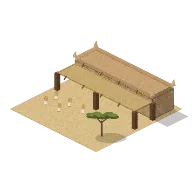
Unlocks at town-centre level 4The mallams teach the Qur’an, the law and the sciences. Makes Knowledge and runs research. Raiders never touch it.

Parade ground
Unlocks at town-centre level 4Where the cavalry parades on feast days. Raises Unity.

The Kaigama’s house
Unlocks at town-centre level 7Home of the commander of the army. Brings him to your forces.

The brick palace
Unlocks at town-centre level 8The palace of fired brick at the heart of Ngazargamu; the ruins of the city still stand near Geidam. Heritage for the ladder.
Defence

Watch post
Unlocks at town-centre level 3Night guards on the city’s lanes. Raises Peace.

Archers’ tower
Unlocks at town-centre level 2Bowmen on a mud-brick tower over the wall.

City wall
Unlocks at town-centre level 4A great earth wall round the city, raised section by section.

City gate
Unlocks at town-centre level 4A guarded gate where an avenue passes the wall.

Musketeers’ post
Unlocks at town-centre level 10Musketeers trained in the Turkish way. Hits hard, reloads slowly.

War council
Unlocks at town-centre level 13The council of state plans the city’s defence. Needed to stand in 1902.
Army

Cavalry stables
Unlocks at town-centre level 2Horses from the north, and the men who ride them. Each level holds more soldiers.

Armourers’ forge
Unlocks at town-centre level 5Spears, swords and coats of mail for the horsemen. Raises Progress.
Landmarks

The salt caravan yard
Unlocks at town-centre level 4Camels unload cones of salt from the desert, and caravans gather for the long road north. Wealth and visitors.

Lake Chad fishing camp
Unlocks at town-centre level 6Reed boats and fish traps on the shallow lake, the heart of the old empire. Food, Unity and visitors.
Research
| Technology | Branch | Effect |
|---|---|---|
| Millet and sorghum | Farming | Hardy grains for a dry land: +10% Food. |
| Clay granaries | Farming | Grain keeps for years: +15% Food storage. |
| Fish from the lake | Farming | Dried fish from Lake Chad: +15% Food. |
| Wells and shadufs | Farming | Water lifted to the fields in the dry season: +20% Food. |
| Mud brick | Building | Bricks dried in the sun: builds 8% faster. |
| Fired brick | Building | Bricks from the kiln, rare in the Sahel: buildings +10% sturdier. |
| Builders’ guild | Building | Guild builders cut costs by 8%. |
| Fortified camps | Building | Idris Alooma’s army builds walled camps fast: builds 10% faster. |
| Iron spearheads | Defence | Better weapons from the forge: +8% damage. |
| Archers on the walls | Defence | Faster, steadier volleys: towers +12% damage. |
| Quilted armour | Defence | Thick quilted coats for horse and rider: +12% unit health. |
| Turkish muskets | Defence | Firearms and trainers from the Ottoman sultan: +12% damage. |
| Cloth money | Trade | Strips of cotton cloth that every market takes: +10% Wealth. |
| The salt trade | Trade | Thousands of tons of salt a year: +12% Wealth. |
| The road to Tripoli | Trade | Caravans across the Sahara: +20% Wealth. |
| Arabic letters | Learning | Scribes write the court’s letters and records: +15% Knowledge. |
| Mallam villages | Learning | Scholars’ villages that pay no tax: research 15% faster. |
| Scholars from abroad | Learning | Teachers from North Africa and Egypt: +20% Knowledge. |
| Festival calendar | Heritage | The great feasts of the year: Faith and Unity rise. |
| The chronicles | Heritage | The court’s scribes record the reigns of the mais: Heritage. |
| The cavalry parades | Heritage | Horsemen in mail and bright cloth: Heritage. |
| Camel troops signature | Heritage | Signature tech. Idris Alooma’s camel corps carries the army’s supplies: Progress and Trust. |
| The great wall signature | Defence | Signature tech. Ngazargamu’s wall ran about 6.6 km round the city: walls 25% stronger. |
Did you know?
- The Sayfawa kings ruled Kanem and then Bornu from the late 11th century until 1846.
- Around 1380 the Sayfawa moved from Kanem, east of Lake Chad, to Bornu in the west.
- Mai Ali Gaji founded Birni Ngazargamu around 1472, on the Yobe River.
- Ngazargamu’s wall ran about 6.6 km round the city; stretches still stand about 5 m high.
- In the 1570s Idris Alooma got muskets and Turkish trainers from the Ottoman sultan.
- Under Idris Alooma the army added camel troops, fortified camps and ferries for crossing rivers.
- Bornu produced an estimated 6,500 to 9,000 tons of salt a year.
- In the 13th century Kanem’s army was said to number 40,000 horsemen.
- The Kaigama, Bornu’s highest general, was often a man of slave birth.
- Copper, silver, cowries and strips of cotton cloth all served as money in Bornu.
- Fulani armies took and destroyed Ngazargamu in 1808.
- Muhammad al-Amin al-Kanemi founded Kukawa in 1814.
- The German traveller Heinrich Barth reached Kukawa in 1851.
- Rabih az-Zubayr conquered Bornu in 1893 and was killed at Kousséri on 22 April 1900.
- In 1907 Shehu Abubakar Garbai founded Yerwa, which grew into Maiduguri.