
Chapters
Kingdom of Benin
Edo · Rainforest and rivers
Play BeninEra I · Before the Flag
The five ages
- 1
Founding
c. 1440 · town-centre level 1Prince Ogun returns from exile and takes the throne as Oba Ewuare. Tradition says fire burned the capital for two days and nights. Rebuild Edo from a handful of compounds: homes, yam farms, a shrine and the first warriors.
- 2
Kingdom
c. 1460–1481 · town-centre level 4From about 1460 the city digs the inner iya, a moat and rampart about 12 km round. Ewuare organises the town chiefs and the palace chiefs, creates the crown prince’s title, Edaiken, and about 1470 the state takes the name Edo.
- 3
Golden age
c. 1481–1550 · town-centre level 7Ozolua “the Conqueror” carries the kingdom’s wars far and wide. Esigie defeats the Igala kingdom in 1515–16 and makes his mother Idia the first Iyoba. The brass casters of Igun Street make the heads and plaques the world knows today.
- 4
Contact
1485–c. 1606 · town-centre level 10The Portuguese reach Ughoton, Benin’s river port, in 1485–86 and build a fort there in 1487. Envoys go to Lisbon, manillas and guns come in, and Esigie opens a school that teaches reading and writing in Portuguese. Pepper and ivory go out as royal monopolies.
- 5
The Scramble
1888–1897 · town-centre level 13Ovonramwen becomes Oba in 1888. A British vice-consul obtains a treaty in 1892, a British party marching on the city is stopped in January 1897, and a punitive expedition follows in February. Here your defences decide.
People of Benin
The figures who appear as the city grows, ruled by the Oba.

Ewuare the Great
Oba, c. 1440–c. 1473Born Prince Ogun, he rebuilt the city after a great fire, guarded its nine gates and gave the state the name Edo.
Portrait: fictional depiction
Emotan
Market woman, 1400sA food seller at the Oba’s market who warned the exiled prince of a plot. Ewuare planted a sacred tree where she traded; her statue stands before Oba Market.
Portrait: fictional depiction
Ozolua the Conqueror
Oba, c. 1481–1504Tradition credits him with no fewer than two hundred victories.
Portrait: fictional depiction
Idia
The first Iyoba, c. 1506In the war with the Igala kingdom she sent troops from her palace at Uselu. Her ivory pendant once had eleven tiny Portuguese heads along its top; ten remain.
Portrait: fictional depiction
Esigie
Oba, c. 1504–1550Won the Igala war of 1515–16, made his mother the first Iyoba, and opened a school that taught reading and writing in Portuguese.
Portrait: fictional depiction
Orhogbua
Oba, c. 1550–1578Schooled in São Tomé and Lisbon, he founded Eko, a fortified war camp on Lagos Island.
Portrait: fictional depiction
Ehengbuda
Oba, c. 1578–c. 1606Called the last of the warrior kings. His canoe capsized in a storm on the way back from Lagos, and his body was never found.
Portrait: fictional depiction
Akenzua I
Oba, c. 1713–1735Defeated the rebellious Iyase n’Ode with the help of the Ezomo, and became one of the richest Obas.
Portrait: fictional depiction
Ovonramwen
Oba, 1888–1897Born Idugbowa in 1857. He gave himself up in August 1897 wearing his coral regalia and died in exile at Calabar in 1914.
Portrait: fictional depiction
Eweka II
Oba, 1914–1933Rebuilt the palace, restored the craft guilds and founded the Benin Arts and Crafts School.
Portrait: fictional depictionYour hero in battle
Iyoba Idia
Queen motherThe first Iyoba, installed about 1506. In the Igala war she sent troops from her palace at Uselu, and her men killed the enemy commander. Ability: Ifianyako. The regiments encircle the enemy, as Benin’s armies did: +35% damage for 12 seconds.
Portrait: fictional depictionThe council
| Seat | Who they are | Speaks for |
|---|---|---|
| The Iyase | Head of the town chiefs | people, trade and the treasury |
| The Ezomo | Supreme war chief, one of the Uzama | the army and Peace |
| The Ihama of the Ihogbe | Keeper of the royal ancestral shrines | Faith |
| The Inneh of the brass casters | Hereditary head of the Igun Eronmwon | Progress and research |
| The Uwangue of the Iwebo | Head of the palace society that runs foreign trade | Wealth and Unity |
| The obo | Diviner and healer | Health |
| The Iyoba | Queen mother, in her own palace at Uselu | Unity and counsel from the third age |
| The Uzama | Kingmakers, who crown the Oba but do not choose him | whether you keep the throne |
Sign or stand
February 1897. In January a British party led by Acting Consul-General Phillips marched on the city although the Oba had asked them to wait; near Ugbine Benin forces stopped them and most were killed. Now about 1,200 sailors, marines and Protectorate soldiers march in three columns with rockets and Maxim guns. Their terms: the palace submits to British rule.
| Sign | Submit. The city stands, but Unity falls hard for a month and British merchants take a cut of every trade. |
| Stand | Stand and fight. The columns attack with everything they have. Hold the palace and history changes. |
What really happened (the game tells you at the end)
The city fell on 18 February 1897, and on 21 February fire destroyed the palace. About 2,500 objects were officially sent to Britain. Ovonramwen gave himself up on 5 August and was exiled to Calabar, where he died in 1914; his son was crowned Eweka II that year and rebuilt the palace. Since 2022 museums in Germany, Britain, the United States and the Netherlands have begun returning the bronzes. Your city rebuilds: the expedition will come again while you stay in the Scramble.
Raiders and bosses
Who comes for the city in each age. Bosses come once you are into their age. How raids work.
| Age | Raiders | Boss |
|---|---|---|
| First Founding | A war band from a rival town | None |
| Second Kingdom | Warriors of a rival kingdom | None |
| Third Golden age | Raiders from a regional power | The army of the Ata of Igala The Igala war, 1515–16 |
| Fourth Contact | Raiders hunting the river trade | None |
| Fifth The Scramble | Raiders on the trade roads | The British punitive expedition February 1897 then sign or stand |
Soldiers
| Soldier | From level | |
|---|---|---|
| Spearman | Village regiments with spear and shield. | 2 |
| Crossbowman | Shoots bolts from behind the spears. | 3 |
| Palace guard | The royal guard: big shields, heavy blades, slow to fall. | 7 |
| Musketeer | Guns from the coast. One heavy shot, a long reload. | 10 |
Buildings
Every building Benin can raise, shown as it looks in the middle of the story. What each type does.
People

Family compound
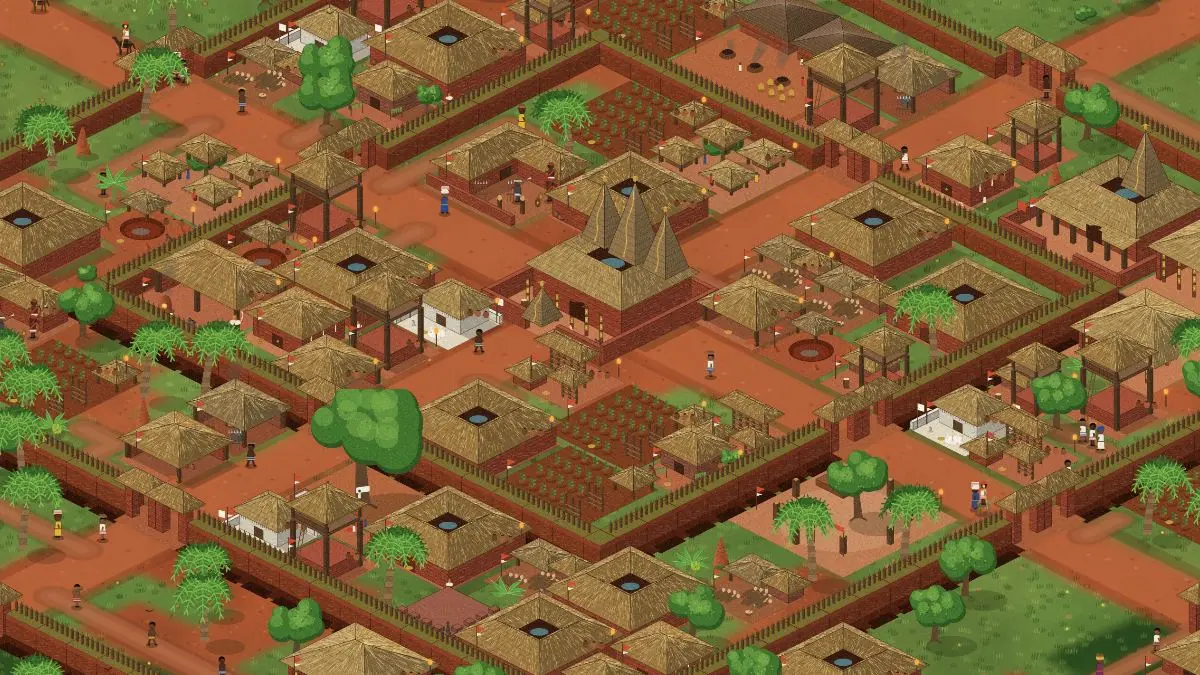
Unlocks at town-centre level 1Windowless red-clay walls around a courtyard whose roof catches the rain. Houses your people, who staff every workplace and fill the regiments.

Healer’s house
Unlocks at town-centre level 4The obo, diviner and healer, works with leaves, roots and bark under Osun, the spirit of herbs. Raises Health, and healthy workers produce more. Raiders never touch it.

Council hall
Unlocks at town-centre level 5Where the chiefs sit with the Oba and settle disputes. Raises Trust and some Peace.
Economy

Yam farm
Unlocks at town-centre level 1Yam mounds with vines on stakes. Tap the farm when it fills to bring the harvest in.

Woodcutters’ camp
Unlocks at town-centre level 1Timber from the rainforest for roofs, posts and doors. Materials.

Clay pit
Unlocks at town-centre level 2Red laterite, puddled into walls and polished until it shines. Materials.

Yam barn
Unlocks at town-centre level 1Racks of tied yams. Raises how much Food you can keep, and raiders can carry off only part of it.

Storehouse
Unlocks at town-centre level 1Timber and clay under a long thatch. Raises how many Materials you can keep.

Cowrie treasury
Unlocks at town-centre level 3Strings of cowries, the money of the city. Raises how much Wealth you can keep.

Oba Market
Unlocks at town-centre level 3Market women trade cloth, pepper, beads and yams; Emotan’s statue stands at the gate today. Wealth, plus a little Unity.

Ughoton river port
Unlocks at town-centre level 10Benin’s port on the river, where foreign ships traded. A large Wealth producer. Must touch the river.
Culture

Olokun shrine
Unlocks at town-centre level 1Olokun, eldest son of the creator Osanobua, rules all waters and gives wealth and fertility. Raises Faith and gives a little lore. Raiders never touch it.

Brass casters’ guild
Unlocks at town-centre level 4The Igun Eronmwon cast heads and plaques for the palace by the lost-wax method; only descendants of Igun Street’s seven original families may cast Benin brass. Makes Knowledge and runs research. Raiders never touch it.

Festival ground
Unlocks at town-centre level 4Open ground for dances, drums and the year’s festivals. Raises Unity.

Iyoba’s palace
Unlocks at town-centre level 7Eguae Iyoba, the queen mother’s own court at Uselu, with her own regiment, the Queen’s Own. Brings Iyoba Idia to your army.

Gallery of plaques
Unlocks at town-centre level 8Brass plaques nailed to the palace pillars record kings, chiefs and battles. Your bronze collection: Heritage for the ladder.
Defence

Ward watch post
Unlocks at town-centre level 3Night guards with drums at the ward boundaries. Raises Peace and keeps thieves off the barns.

Archers’ platform
Unlocks at town-centre level 2Crossbowmen shoot from a raised, thatched platform at anyone who comes for the city.

Iya
Unlocks at town-centre level 4Dig the iya segment by segment: a deep ditch with the earth heaped into a rampart behind it, in places 17 metres from bottom to top. Raiders must break through or find a gate.

Iya gate
Unlocks at town-centre level 4A guarded gate where one of the long straight avenues crosses the iya.

Musket post
Unlocks at town-centre level 10Guns from the coast behind a thick mud wall. Hits hard, reloads slowly.

War council
Unlocks at town-centre level 13The chiefs plan the city’s defence against the expedition. Needed to stand in 1897.
Army

War camp
Unlocks at town-centre level 2The village regiments drill here. Each level holds more soldiers.

Blacksmiths’ forge
Unlocks at town-centre level 5Iron for spears, hoes and blades. Raises Progress.
Landmarks

Emotan’s tree
Unlocks at town-centre level 4The sacred tree Ewuare planted where Emotan, the market woman who warned him of a plot, once sold her food. Unity, Heritage and gifts from visitors.

Igun Street
Unlocks at town-centre level 6The quarter of the Igun Eronmwon, the royal guild of brass casters, with its workshops and altars. Unity, Faith and visitors’ trade.
Research
| Technology | Branch | Effect |
|---|---|---|
| Yam mounds | Farming | Heaped mounds drain the soil: +10% Food. |
| Yam barns | Farming | Tied yams keep for months: +15% Food storage. |
| Plantain and palm groves | Farming | More crops in the forest gaps: +15% Food. |
| Cassava and maize | Farming | New crops from the Americas, brought by the coastal trade: +20% Food. |
| Laterite walls | Building | Puddled red earth sets hard: builds 8% faster. |
| Polished walls | Building | Walls rubbed smooth and hard: buildings +10% sturdier. |
| Carpenters’ guild | Building | Guild-made posts and doors: builds cost 8% less. |
| Master builders | Building | Palace builders train the wards: builds 10% faster. |
| Iron spearheads | Defence | Ogun’s forge sharpens the regiments: +8% damage. |
| Crossbow drill | Defence | Faster, steadier volleys: towers +12% damage. |
| Hide shields | Defence | Better shields for the regiments: +12% unit health. |
| Guns from the coast | Defence | Firearms for towers and troops: +12% damage. |
| Cowrie standard | Trade | One money for the whole market: +10% Wealth. |
| Trade roads | Trade | Safer roads to the market towns: +12% Wealth. |
| Ughoton trade | Trade | Pepper, cloth and ivory for foreign ships: +20% Wealth. |
| Palace societies | Learning | The palace associations train the young: +15% Knowledge. |
| Apprentices | Learning | Guild masters take on more apprentices: research 15% faster. |
| Chroniclers of the court | Learning | Remembrancers keep the kings’ history: +20% Knowledge. |
| Festival calendar | Heritage | A year of festivals for the Oba and the city: Faith and Unity rise. |
| Commemorative heads | Heritage | Brass heads for the ancestral altars: Heritage. |
| Coral regalia | Heritage | Coral-bead crowns and collars for the court: Heritage. |
| Igun Eronmwon lost-wax casting signature | Heritage | Signature tech. Bronzes add Heritage and Progress. |
| Iya earthworks signature | Defence | Signature tech. Every iya segment is 25% stronger. |
Did you know?
- Benin’s inner moat, the iya, ran about 12 km and was built around 1460.
- In places the drop from the bottom of the moat to the top of the rampart reached 17 metres.
- With the rural iya beyond the city, the earthworks may run for more than 16,000 km.
- One estimate: 5,000 men working 10-hour days could have dug the inner moat in 97 days.
- Nine gates pierced the city rampart; tradition says charms lay buried beneath them.
- Around 1600 the Dutch visitor Dierick Ruiters rode in past “a very high bulwark, very thick of earth”.
- In 1668 Olfert Dapper wrote that the palace was as large as the Dutch town of Haarlem.
- In 1691 a Portuguese captain called Benin larger than Lisbon, its streets straight as far as the eye could see.
- The city’s quarters were named after the guilds that lived in them.
- Only descendants of Igun Street’s seven original families may cast Benin brass.
- The Igbesanmwan, the royal ivory carvers, also worked in wood, brass and coral.
- Plaques were cast about 3 mm thick; most date from the 1540s to about 1570.
- Melted-down manillas fed the casters; their brass is now thought to have come from Germany’s Rhineland.
- Coral beads are ivie in Edo; only the Oba could grant the right to wear coral neck rings.
- Olokun, eldest son of the creator Osanobua, rules all waters and gives wealth and fertility.
- The Portuguese built a fort at Ughoton, Benin’s river port, in 1487.
- A Portuguese chronicler wrote that Europe’s first “Guinea pepper” came from Benin.
- Igue, held between Christmas and New Year, renews the Oba’s powers.
- Ugie Oro celebrates Esigie and Idia’s victory over the Igala kingdom.
- Benin’s regiments fought with spears, short swords, bows and crossbows, and encircled their enemies: ifianyako.
- Horses were rare in Benin, which only added to their prestige; brass plaques show chiefs on horseback.
- About 2,500 objects were officially sent to Britain after 1897.
- In December 2022 Germany handed over its first 20 bronzes in Abuja; its museums held about 1,100.
- Oba Ewuare II, crowned on 20 October 2016, was once Nigeria’s ambassador to Sweden, Angola and Italy.